0.2 — What Is a Markup Language?
At its core, a markup language is a system for annotating a document in a way that is syntactically distinguishable from the text. The annotations – often called tags, commands, or tokens – interleave explicit structural instructions directly alongside the content they govern. This makes the document self‑describing: a human or a machine can read the raw file and understand where each logical block begins and ends, how it is nested, and what role it plays.
Markup does not dictate the final visual appearance – that is the job of a style language like CSS. Markup declares what something is: a heading, a paragraph, a list, a figure. The rendering engine decides exactly how that declaration looks.
The Markup Family Tree: A Panorama of Syntax Paradigms
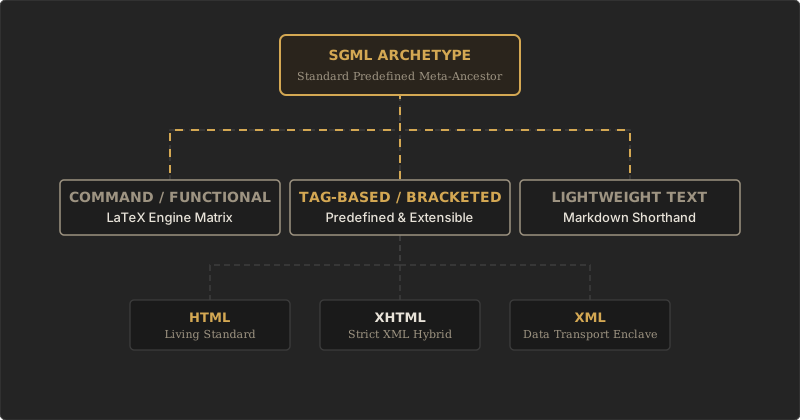
The concept of “markup” has evolved into a diverse family of languages, each with its own syntax philosophy and intended purpose. The following diagram illustrates the major branches of this family tree.
Anatomy of the Paradigms
Each branch operates under a distinct set of syntactic rules, yet all serve the same fundamental goal: adding machine‑readable structure to human‑readable content.
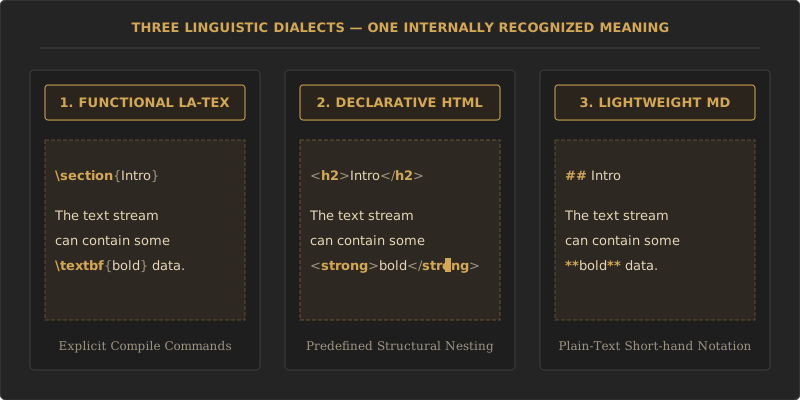
- Command / Functional (LaTeX) – Structural directives are written as backslash‑prefixed commands:
\section{Introduction}. The content is wrapped in braces and the command explicitly declares its role. - Tag / Bracket – SGML (Meta‑ancestor) – The grandfather of all modern markup. SGML introduced the concept of angle‑bracket tags, attributes, and a formal Document Type Definition (DTD) that strictly defines the document grammar.
- Standard Predefined Web – HTML – A fixed vocabulary of tags directly derived from SGML. HTML sacrifices syntactic strictness for robustness and ease of authoring. Browsers silently correct errors to keep the web from breaking.
- Data Description & Transport – XML – A strictly conforming subset of SGML. XML demands perfect nesting, case‑sensitive tags, and explicit closing. A single syntax error renders the entire document invalid, making it ideal for data interchange where integrity is paramount.
- Strict Ruleset Hybrid – XHTML – An attempt to marry the vocabulary of HTML with the rigid syntax of XML. It required web authors to write flawless, well‑formed code, a constraint that proved too brittle for the messy, forgiving real‑world web.
- Lightweight / Plain‑text – Markdown – A readability‑first syntax that maps common keyboard symbols (
#,**,-) to structural meaning. Designed to be as easy to read in raw form as in rendered output, without any visible tag ceremony.
The Parser’s Hidden Pipeline: From Bytes to a Document Tree
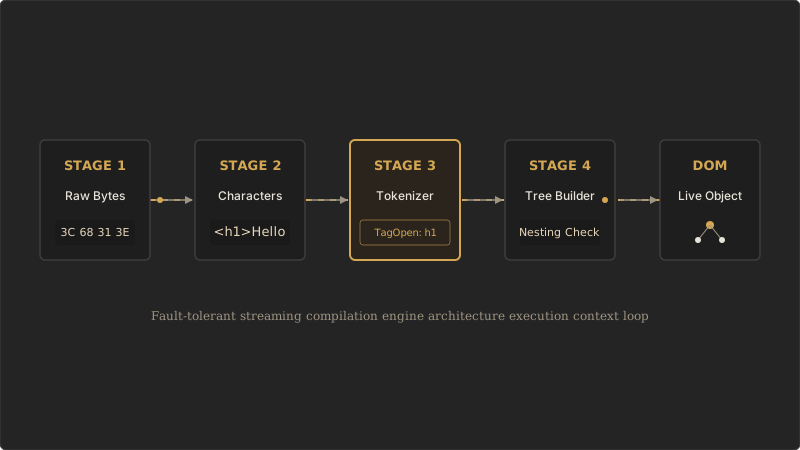
Before a browser can render a single pixel, the raw markup must be parsed. The parser reads the file as a stream of bytes, converts them to characters, then tokenizes the characters into meaningful chunks (start‑tags, end‑tags, text, attributes). These tokens feed a tree‑construction algorithm that builds the Document Object Model (DOM) – a live, hierarchical representation of the document in memory.
Crucially, the HTML parser is designed for real‑world resilience. It never crashes on bad input; instead it applies a detailed error‑recovery algorithm to fix common mistakes (unclosed tags, mis‑nested elements) and produce a usable DOM anyway. This tolerance is the bedrock of the web’s backwards compatibility.
A markup language is a structured dialect of annotation. Its syntax may vary – backslashes, angle brackets, or plain symbols – but its purpose is constant: to transform a flat stream of text into a navigable, meaningful, machine‑readable tree. In the next section, we’ll explore the philosophical principle that keeps this tree cleanly separated from its visual skin: the Separation of Concerns.