1.1 — From Hypertext to the Living Standard
HTML stands for HyperText Markup Language. To truly understand it, we must break down that name – because HTML was born from two separate ideas that collided to change the world.
The Dream of Connected Information
In the late 1980s, digital documents were isolated islands. Reading a research paper on a computer meant you could not simply jump to a referenced study – you had to manually find the other file on a different machine. The process was slow and frustrating.
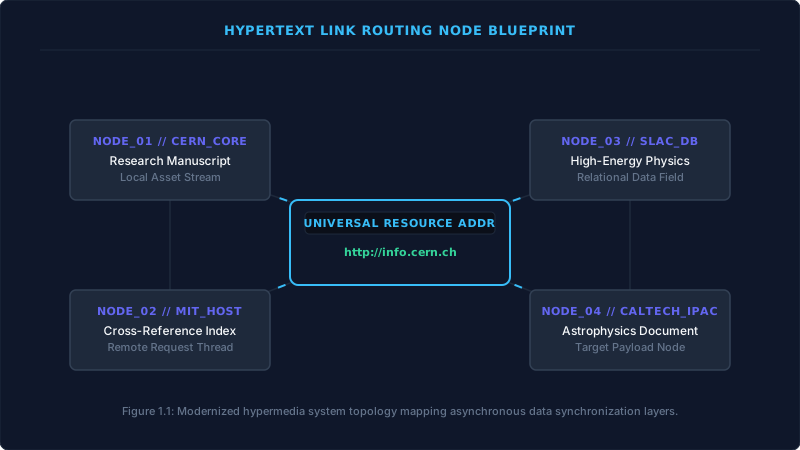
Then came Hypertext – text containing active connections, or hyperlinks, to other texts. In 1989, a British software engineer named Tim Berners-Lee had a revolutionary insight while working at CERN: combine hypertext with the internet’s existing network protocols, and you could link the entire world’s information. For the first time, a researcher in Geneva could click a link and instantly retrieve a document from a server in California.
But these early hypertext pages were just plain, unstyled text. They had no internal organisation – no headings, no paragraphs, no way to tell where one idea ended and another began. The content was an undifferentiated stream.
Marrying Hypertext with Markup
To give documents structure, Berners-Lee did something ingenious: he took the concept of markup – the editorial annotations we explored in Chapter 0 – and embedded it directly into hypertext. The result was the HyperText Markup Language. A document could now contain explicit labels that told a computer, “This bit is a heading,” “This is a paragraph,” or “This word is a hyperlink.”
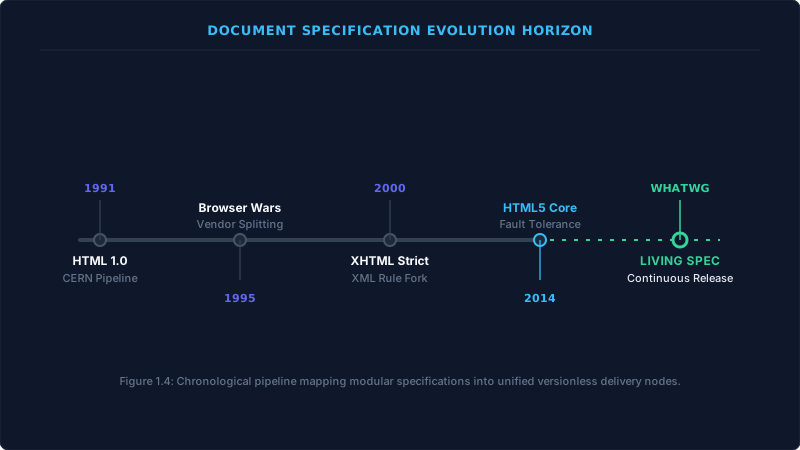
The first official version of HTML, released in 1991, contained only 18 basic tags. It was a tiny vocabulary, yet it was enough to build the web’s first pages. Many of those original tags – like <h1>, <p>, <a>, and <ul> – are still in use today, virtually unchanged.
<title>, <h1> through <h6>, <p>, <a>, <ul>, <ol>, <li>, <dl>, <dt>, <dd>, <address>, <pre>, <hr>, <plaintext>, <listing>, <nextid> – and a few others. A tiny seed that grew into the web.
The Browser Wars: Chaos and Fragmentation
By the mid-1990s, the web had exploded. Two corporate giants – Netscape and Microsoft – fought for dominance in the browser market. Instead of adhering to a shared standard, each company began inventing its own proprietary HTML tags to lock users into its platform.
Netscape introduced the <blink> tag, which made text flash on and off. Microsoft countered with the <marquee> tag, which scrolled text across the screen. Websites had to include multiple code branches – one for Netscape Navigator, one for Internet Explorer – or risk looking broken. This era shattered the web’s uniformity and made life miserable for developers.

The Push for Strictness: XHTML’s Failed Experiment
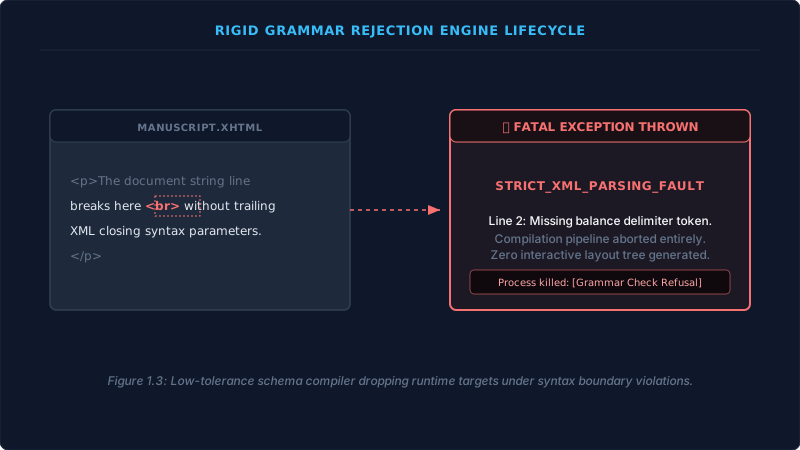
To restore order, the World Wide Web Consortium (W3C) attempted to enforce absolute strictness. They created XHTML, a version of HTML that followed the rigid rules of XML. Every tag had to be closed, every attribute quoted, and the slightest syntax error would cause the entire page to crash with an error message instead of displaying content.
In theory, it was elegant. In practice, it was disastrous. The web is messy – content comes from millions of authors, many of whom make small mistakes. A visitor who encountered a missing slash was shown nothing at all. The approach broke countless sites and alienated developers. The web’s resilience had been sacrificed for purity.
The Modern Living Standard
Realising the web needed a forgiving, backwards‑compatible approach, a group of browser engineers broke away and formed the WHATWG (Web Hypertext Application Technology Working Group). They launched HTML5 – a powerful, realistic specification that embraced the web’s chaotic nature.
Today, HTML has no version numbers. There will never be an “HTML6”. Instead, it is a Living Standard – a continuously updated document that evolves incrementally. New features are added only when they are proven to work across all major browsers. Old code never stops working. Pages written in 1991 still render correctly. This commitment to eternal backward compatibility is what keeps the web’s foundation rock‑solid.
Understanding HTML’s history is not just trivia. It explains why the language is forgiving when you make a mistake, why certain old tags still work, and why we focus on meaning (semantics) rather than visual tricks. You are now part of a lineage that stretches from a single researcher’s desk at CERN to every smartphone in the world.