10.4 — Character Encodings & The 1024‑Byte Buffer Rule
The entire parsing pipeline depends on one critical assumption: the browser knows the character encoding of the incoming bytes. A wrong guess can corrupt tokenization, destroy layouts, and produce the garbled text known as Mojibake. The browser uses a strict multi‑layer evaluation path to determine the encoding, governed by the hard 1024‑byte rule.
The Three‑Layer Codec Evaluation Path
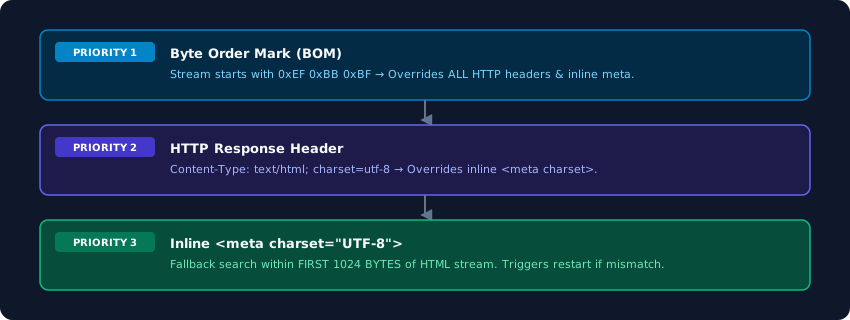
When the first bytes arrive, the browser determines the encoding by checking three sources in strict order of authority:
- Byte Order Mark (BOM) – If the stream starts with the bytes
EF BB BF(UTF‑8 BOM), the encoding is locked instantly. The BOM overrides everything else. - HTTP Content‑Type Header – If no BOM, the engine looks at the
charsetparameter from the server’s response header (e.g.,Content-Type: text/html; charset=utf-8). - Inline
<meta charset>– If both BOM and HTTP header are absent, the parser must read the HTML itself to find<meta charset="UTF-8">.
The absence of the first two layers forces the browser into speculative parsing, which is where the 1024‑byte rule becomes critical.
The 1024‑Byte Rule & Speculative Restart
Without a definite encoding from the BOM or HTTP header, the browser must guess. It chooses a default (often Windows‑1252 or ISO‑8859‑1) and begins tokenizing and building a speculative DOM tree.
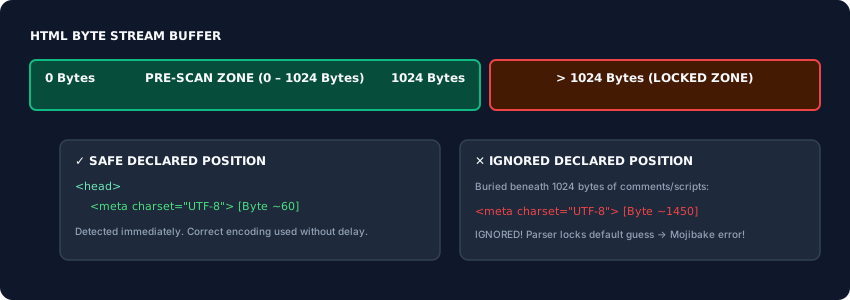
The engine continuously watches for an inline <meta charset>. The specification enforces a strict spatial boundary: this search only happens within the first 1024 bytes of the HTML stream.
- Found within 1024 bytes and matches guess: parsing continues seamlessly.
- Found within 1024 bytes and differs from guess: the browser triggers a speculative restart. It destroys the provisional DOM, resets the stream, switches to the declared encoding, and starts over.
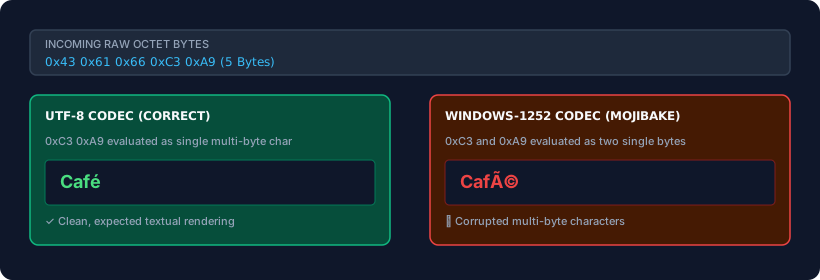
- Not found within 1024 bytes: the guess is locked permanently. If the guess was wrong, all subsequent multi‑byte characters become garbled – Mojibake.
Preventing the Catastrophe
To eliminate speculative restarts and avoid Mojibake, the <meta charset> tag (or better, the HTTP header) must appear as early as possible – ideally at byte zero or within the first few characters. Place it immediately after the opening <head> tag, before any other elements, scripts, or comment blocks.
<head>
  <meta charset="UTF-8">
  <title>…</title>
  …
</head>
This simple discipline guarantees that the browser never guesses, never restarts, and always decodes your content perfectly.
Character encoding is the foundation of parsing. The browser follows a strict hierarchy: BOM, then HTTP header, then inline <meta charset>. The 1024‑byte rule dictates that the charset must be declared early, or the browser will lock in a potentially wrong guess, leading to catastrophic layout drops and garbled text. Always declare your encoding as close to byte zero as possible – ideally in the HTTP header or as the first child of <head>.