11.2 — SEO Mappings
Search engine optimisation is a structural data‑mapping problem. Crawlers execute the same rendering pipeline as browsers – parsing tokens, building DOM trees, and constructing semantic outlines. By understanding exactly how these bots weigh headings, interpret landmarks, and prioritise content, you can architect pages that achieve maximum search visibility with zero marketing fluff.
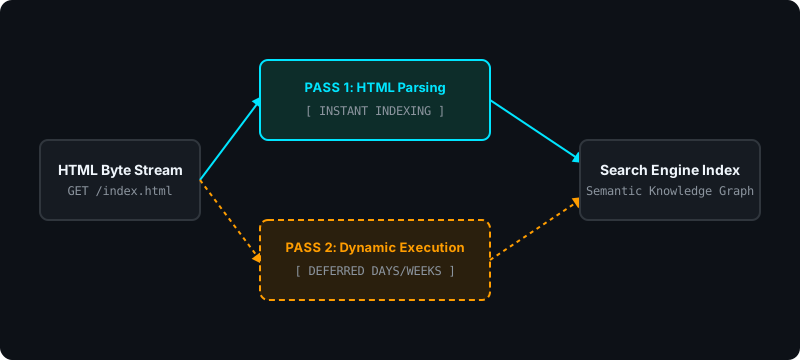
The Crawler's Two‑Pass Architecture
When a search bot discovers your URL, it executes two distinct ingestion passes:
- Pass One: The bot downloads the raw HTML byte stream, runs tokenization, and builds the primary DOM tree. It instantly extracts headings, links, meta tags, and text content – committing this to the search index in real time.
- Pass Two: The bot launches a full browser rendering engine to execute scripts and parse dynamic content. This pass consumes massive cloud resources and is frequently deferred by days or even weeks.
Because our architectural paradigm relies on pure, server‑delivered HTML, our pages achieve a massive competitive advantage. One hundred percent of your content, metadata, and structural weight is captured instantly in the first pass, bypassing the scheduling delays of the secondary rendering layer entirely.
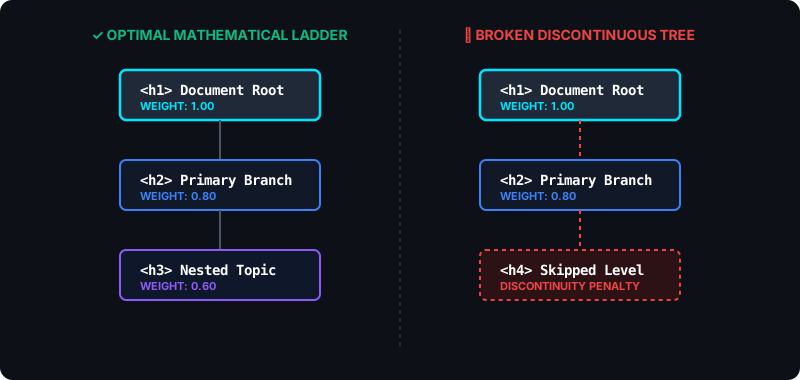
Heading Hierarchy – The Mathematical Outline
Crawlers read heading levels as mathematical node weights that define parent‑child topic relationships. The rules are absolute:
<h1>– the singular, primary topic of the entire page. Exactly one per document.<h2>– a direct sub‑topic branching from the h1 root.<h3>– a nested sub‑topic under a specific h2.- The chain continues unbroken down to
<h6>.
Skipping a level – such as jumping from <h2> directly to <h4> – creates a structural discontinuity. The crawler's outline algorithm cannot determine the relationship between those nodes, and the page suffers a categorisation penalty. Headings must be authored as a continuous, mathematically strict ladder, completely decoupled from visual size preferences.
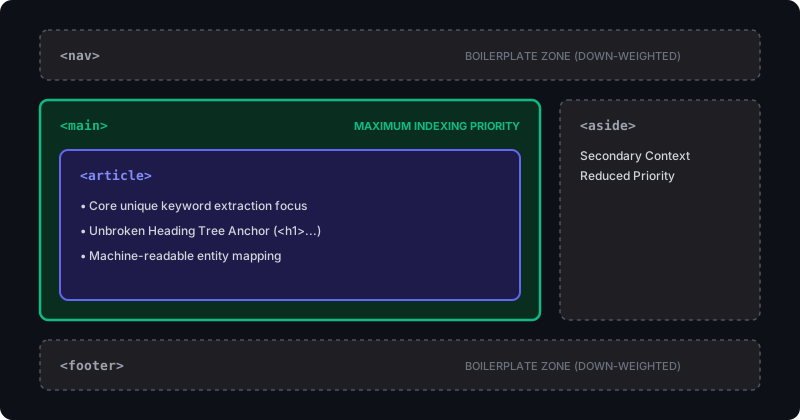
Semantic Element Prioritisation
Before semantic landmarks existed, layouts were built from generic <div> wrappers – invisible, anonymous boxes that forced crawlers to guess which content mattered. Modern semantic elements eliminate this ambiguity:
<main>– signals the core, unique content of the page. The crawler focuses its primary keyword extraction here, assigning maximum structural priority.<article>– identifies a self‑contained, distributable piece of content. Ideal for blog posts, news stories, and product descriptions.<section>– groups thematically related content, provided it contains a heading to anchor its role in the outline.<nav>and<footer>– recognised as boilerplate zones. The crawler intentionally down‑weights their content to prevent repetitive navigation and copyright text from diluting the page's unique keyword focus.
By wrapping your primary content in <main> and <article>, and isolating navigation and legalese in their proper landmarks, you explicitly guide the crawler's mathematical focus – ensuring your unique data is indexed with maximum fidelity.
Enterprise Blueprint – A Search‑Optimized Blog Article
The following markup demonstrates a perfectly structured article optimized for search crawlers. Every heading follows the strict mathematical ladder; every content block lives inside the correct semantic landmark.
<main>
  <article itemid="https://domain.com/post">

    <h1>Architectural Analysis of Modern Browsers</h1>

    <section>
      <h2>The Ingestion Pipeline</h2>
      <p>The rendering engine parses raw network binary blocks
         directly inside the stream buffer.</p>
    </section>

    <aside>
      <h3>Related Ingestion Standards</h3>
    </aside>

  </article>
</main>
Architectural Analysis of Modern Browsers
The Ingestion Pipeline
The rendering engine parses raw network binary blocks directly inside the stream buffer.
With this structure, the crawler captures the <main> content at maximum priority, traces the unbroken heading chain (h1 → h2 → h3) to map the topic hierarchy, and deprioritises any boilerplate outside the core article. The itemid attribute provides a globally unique machine identifier, further strengthening the page's identity in the search index.
SEO is architecture, not marketing. Serve all content in the initial HTML byte stream to guarantee instant first‑pass indexing. Build a strict, unbroken heading ladder from <h1> to <h6>. Wrap core content in <main> and <article>; isolate boilerplate in <nav> and <footer>. When you treat your document as a machine‑readable data graph, search engines reward you with clarity, priority, and visibility.